Why Knowledge Must Become a National Asset: Building Intelligent Governments

In a world where crises emerge faster than governments can react, the strategic management of knowledge could save lives, economies, and democracies.
A Silent Crisis in Crisis Management
When COVID-19 struck, the world’s governments scrambled to respond, with leaders focused on securing ventilators, vaccines, and implementing travel restrictions. Yet beneath the immediate chaos, a more profound, quieter problem was unfolding: governments lacked the necessary infrastructure to rapidly access, share, and act upon the vast amount of knowledge they had at their disposal. It wasn’t a lack of information; it was the absence of organized, accessible institutional memory when it was most needed.
As COVID-19 spread, officials were forced to search outdated email inboxes, legacy drives, and even rely on informal calls to retired specialists. Despite possessing ample data and past reports, the critical knowledge required to make informed decisions was scattered, siloed, and hidden away, leaving governments vulnerable to inefficiency, mistakes, and missed opportunities. The question is, how do we avoid this fate in the next global challenge? The answer lies in building a national knowledge infrastructure, a system that ensures knowledge is not only preserved but made actionable and accessible.
The National Knowledge Deficit: The Gap Between Data and Wisdom
In our rapidly modernizing world, countries are implementing e-government platforms, upgrading service delivery, and developing digital networks. While progress is evident, a fundamental piece of the puzzle is being overlooked: institutional memory. Every department, agency, and ministry harbors invaluable knowledge derived from years of experience and countless projects. But far too often, this knowledge is lost due to retirements, staff turnover, or political reshuffles.
This gap in institutional memory is more than an inconvenience; it has far-reaching consequences. When governments lose their experienced workers, they lose the tacit knowledge accumulated over years of navigating complex systems, working with key stakeholders, and understanding the intricacies of policy implementation. The result is a fragmented system where decisions are made without the benefit of historical context, leading to repeated mistakes and inefficiency.
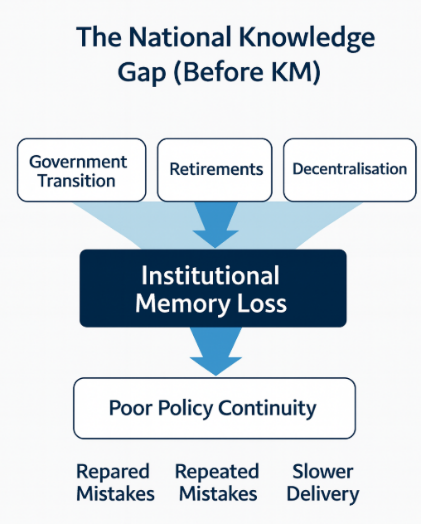
A key example is the Government of Kenya, which faced these challenges head-on. In collaboration with a Knowledge Management (KM) initiative, Kenyan officials sought to bridge this gap by creating a system that would allow critical knowledge to flow seamlessly across ministries, counties, and levels of government. The idea was simple: build a platform where lessons learned from past crises, infrastructure projects, and public health efforts could be cataloged, shared, and acted upon by future decision-makers.
This is where Knowledge Management (KM) becomes a game-changer. KM is not about merely storing reports and PDFs, it’s about transforming knowledge into a national asset. It’s about creating a system that can identify expertise, codify tacit knowledge, and connect decision-makers across jurisdictions. By implementing a KM framework, governments can ensure that expertise is preserved and that lessons learned are applied in real time, improving policy resilience, accelerating development, and bridging generational gaps in the public workforce.
The Failure Modes Exposed by the Pandemic
The pandemic exposed three primary failure modes in how governments manage knowledge:
- Visibility: Governments lacked the ability to quickly identify who knew what and where that knowledge was stored. This led to delays and inefficiencies in decision-making.
- Retrieval: Even when reports and playbooks existed, they were often locked in silos, making it difficult for officials to access the right information at the right time.
- Transfer and Application: Lessons learned from past crises were rarely codified into actionable guidance or procedures, meaning that valuable insights were not passed along to those who needed them most.
The COVID-19 crisis highlighted the need for a comprehensive system to manage knowledge, one that ensures that lessons from the past are integrated into decision-making processes and that expertise is available to policymakers whenever and wherever it’s needed. This is where a national knowledge infrastructure comes in, creating a system of shared knowledge, expert communities, and accessible lessons that can be drawn upon in times of crisis.
From Knowledge to Action: The Blueprint for a Knowledge-Driven Public Sector
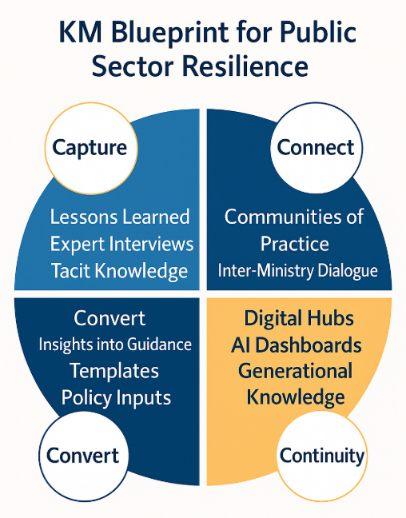
To address these challenges, the concept of Knowledge Management (KM) in government needs to evolve from a theoretical model into a practical blueprint. This blueprint should not just be about creating software solutions; it should be about creating a cultural shift in how governments view and manage knowledge.
The approach begins with identifying critical knowledge before it’s lost. This involves mapping key processes, roles, and decisions where the loss of expertise could have a detrimental impact on service delivery. Governments must work to retain and transfer tacit knowledge, ensuring that the expertise of retiring civil servants is captured and shared. This includes developing a repository of lessons learned, creating structured Communities of Practice (CoPs), and launching mobile-enabled platforms that allow knowledge to be accessed and shared by anyone in the public sector.
This framework has been introduced and discussed with public-sector stakeholders and development partners exploring how to strengthen institutional memory and decision continuity. The approach addresses common challenges such as knowledge silos, staff turnover, and fragmented learning across large organisations. By showing how lessons from one project can inform another—turning a single success into shared institutional intelligence—the model demonstrates how structured knowledge management can accelerate learning, innovation, and resilience across sectors.
The goal is not only to preserve knowledge but to make it actionable. By digitizing knowledge, creating repositories, and establishing clear governance models, KM empowers governments to make decisions based on the wisdom of those who have gone before.
The Role of AI in Enhancing Knowledge Management
One of the most promising aspects of modern KM systems is their integration with artificial intelligence (AI). AI can help automate the process of summarizing reports, generating project dashboards, and surfacing relevant insights in real time. However, AI is only as effective as the knowledge it is built upon. Without a solid foundation of human insight, what worked, what failed, and why, AI-driven features can’t deliver the desired results.
By integrating AI into a KM platform, governments can enhance their ability to respond to crises. AI can sift through vast amounts of data, identify patterns, and present insights to decision-makers in a digestible format. This can help officials make more informed decisions, faster and with greater confidence. For example, AI can analyze past public health responses and generate summaries of what strategies worked best in previous outbreaks, helping decision-makers identify the most effective course of action in future crises.
Toward a Knowledge-Driven Government: The Future of Knowledge Management
Looking forward, it is clear that the future of governance will be shaped by countries’ ability to manage knowledge effectively. Governments that learn faster and make knowledge a strategic asset will be better equipped to handle emerging challenges, from pandemics to climate change to political unrest.
The adoption of Knowledge Management systems can help governments turn experience into foresight, enabling them to respond to crises with greater agility and wisdom. By capturing, connecting, and converting knowledge into actionable insights, governments can ensure that future generations of public servants have access to the expertise and lessons that have been gathered over time.
Biz Weekly Contributor
Covers business, leadership, and entrepreneurship, highlighting emerging companies and the people behind them.
This article features partner, contributor, or branded content from a third party. Members of the Biz Weekly editorial staff were not involved in the creation of this content. All views and opinions are those of the contributor alone.