The Attacker Works Weekends Now
A criminal broke into a company website for just $50 in AI tokens this month, changing the economics of cyberattacks.
By: Steve Copeland
In early October a Chinese-speaking operator pointed an open-source AI hacking tool called Cairn at more than 1,200 online shops. Cairn was written for authorized penetration testing. Nobody asked permission. The agents worked for about three weeks, broke into the websites of more than 100 companies, including Deere, SharkNinja, and Cummins, and left behind web shells for return visits. A security researcher in Norway found the attacker's control panels sitting open on the internet and did the math: roughly $5,000 in total AI spend, a success rate of about one in ten, and about $50 per successful break-in. A successful intrusion took the agents just under 23 hours on average, and no human was sitting at a keyboard for most of it.
I have run IT companies for most of my working life. The thing I keep coming back to is not the technique. It is the invoice. Fifty dollars a company. That is less than I pay for lunch for the sales team.
The agents do not go home
The Cairn campaign was a criminal with a budget. The one that worries me more was a government with one. On October 21 Microsoft published its analysis of the ConnectWise Cloud Backup breach, the incident where a stolen vendor credential opened 173 companies' Microsoft 365 accounts in a single morning. Microsoft attributed it to Storm-0940, a China-aligned group, and said the group ran it on ARTEX, another open-source framework that chains AI agents from reconnaissance through data theft.
Microsoft's numbers are the ones every business owner should sit with. The agents attempted sign-ins at more than 2,250 companies. They managed over 200 successful sign-ins in under four minutes. In several cases the time from picking a target to holding administrator-level access was under three hours. Microsoft's own phrasing was that the agents "are not constrained by factors affecting humans," meaning they work nights, weekends, and holidays, and try several doors at once.
That last part is the change. A human attacker picks a target and works it. An agent takes a list of two thousand and works all of them, and the ones that fail cost nothing. Your company does not have to be interesting anymore. It only has to be on the list.
The holes are being found faster than they are being fixed
The other half of October was AI on the research side. Models from OpenAI and Google found critical flaws in PHP, the language behind roughly 70% of websites, that had been sitting there for decades. Then another one in Brotli, a compression library inside Node.js, Python, and a long list of other software. Security teams started calling the month Black October. Chris Krebs, who ran CISA, told CNBC that 3% of all critical vulnerabilities ever discovered were found in the last month, and that it will get worse before it gets better.
The defenders mostly won this round. Millions of exploit attempts produced few confirmed breaches, partly because the bugs were hard to weaponize and partly because a lot of people patched over a weekend. Axios called it a Y2K lesson: a scare that bought a grace period. I agree, with one edit. The grace period belongs to the companies that use it.
Here is why those two stories are one story. The same tools that find a 20-year-old flaw in PHP can be pointed at your Microsoft 365 account, your website, and your vendors' software, and the people pointing them no longer need to be experts. Cairn's author said in public that the tool was not built for crime. It did not matter.
The third front is inside your own building
While attackers were adding AI, so were your employees, and so was every piece of software you already pay for. IBM's 2026 Cost of a Data Breach report found that unsanctioned AI tools were involved in 43% of breached organizations, up from 20% a year earlier, and that those breaches cost about $670,000 more than the average. Verizon's 2026 report put employee use of AI tools on company devices at 45%, up sharply in a year. ISACA found most companies still have no active AI policy.
The part that gets missed is that shadow AI is no longer mostly an employee pasting a contract into a chatbot. It is the CRM that added an AI assistant in a point release. It is the meeting-notes app someone connected to the company calendar that now reads every invite. It is a Copilot license somebody turned on for a department and forgot. Each of those got there through the same consent screen the ConnectWise backup app did, and each one holds a standing key to some part of your company. When I run the application review on a mid-sized company's Microsoft 365 account, I routinely find a hundred or more connected apps, a quarter of them with AI features, and nobody who can say who approved half of them.

What speed does to a defender
I wrote a book called The 3AM Test. The premise is that the measure of an IT provider is what they know about your business at three in the morning when something is on fire. October added a clause. Three hours is now a realistic time from first contact to full administrator access, and the agent doing it does not care that it is Saturday.
That compresses the only advantage a defender ever had, which is time. Time to notice the alert. Time to find the person who can act on it. Time to figure out which of your connected apps the attacker is now wearing. If you have to start that investigation from zero, by building the inventory of what is connected and what it can touch while the attack is running, you have already lost the race. Microsoft said as much in its ConnectWise guidance: the activity generates alerts, but the speed leaves very little time to respond to them in a coordinated way.
The companies that come through this period well will be the ones that did the inventory before they needed it. Not a scan when something breaks. A dated record of what is connected, what each thing can reach, who approved it, and whether it is in use, refreshed often enough to be true.
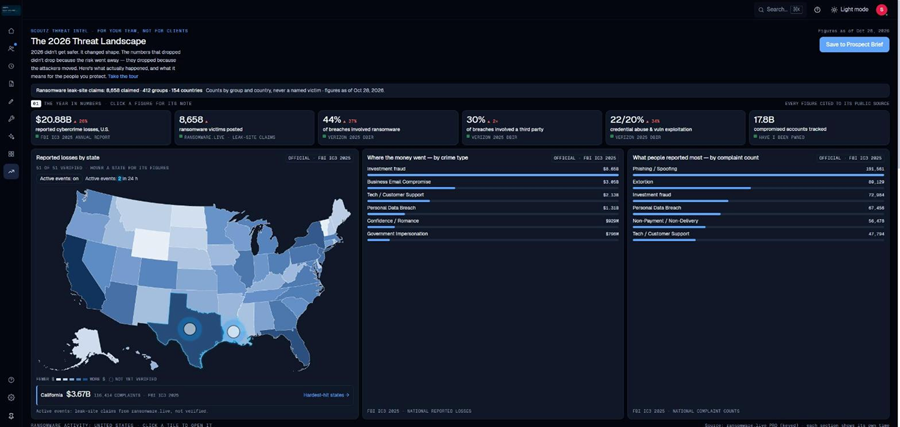
The numbers behind this piece, as SCOUTz shows them to a provider: $20.88 billion in reported U.S. cybercrime losses, 44% of breaches involving ransomware, 30% involving a third party, each figure cited to its public source.
Where SCOUTz fits
I built SCOUTz to help IT providers identify and explain security risks clearly. It reviews a company’s public-facing digital setup, then, with written authorization, conducts a read-only review of its Microsoft 365 identities, settings, connected apps, permissions, AI tools, and unused licenses.
SCOUTz installs no software and does not read email, files, chats, or AI prompts. Each finding includes its source, date, confidence level, and visibility limits, helping providers prioritize meaningful risks without overstating them.
SCOUTz does not block attacks; a provider’s security tools do that. Instead, it gives businesses a current map of their connected applications and access permissions, so when an alert fires at 3 a.m., they can respond without starting their investigation from scratch.
What to do this quarter
Ask your IT provider for the inventory. Every application connected to your Microsoft 365 account, what it can read or change, when it was approved, and whether anything has used it in 90 days. Ask which ones have AI features and which employees are using AI tools the company never approved. Put a date on the request and a date on the next refresh.
Then do the boring thing the Black October defenders did. Patch on the weekend when the notice comes. Turn off the apps nobody can explain. Treat the next Cairn as already running, because at $50 a company, it is.
If you run an IT company and want to be the one who walks in with that map already drawn, a half-hour demo on a real prospect is all it takes. Book the demo at scoutzsecurity.io/demo or join the open beta at scoutzsecurity.io.
Biz Weekly Contributor
This article features <a href="https://bizweekly.com/terms-and-conditions/" target="_blank">branded content</a> from a third party. Opinions in this article do not reflect the opinions and beliefs of Biz Weekly.
This article features partner, contributor, or branded content from a third party. Members of the Biz Weekly editorial staff were not involved in the creation of this content. All views and opinions are those of the contributor alone.