Agile Can’t Keep Up. But AfterAgile Can.
Z Experience Collective introduces a product development methodology and framework built for teams that ship with AI, and need to know whether it worked.
AI has made building software the easy part. A feature that once required a full sprint now ships before lunch. But the decisions surrounding that feature — what to build, who it serves, whether it moved the needle — still take just as long as they ever did.
That gap is growing. Teams are producing more and learning less. Backlogs are shrinking while uncertainty about what actually matters is not. Traditional Agile, built around two-week sprints, daily standups, and end-of-cycle retrospectives, was never designed for a world where execution outpaces judgment.
Z Experience Collective is addressing that gap with AfterAgile™, a product development method that replaces the sprint cycle with a weekly rhythm connecting customer intent to measurable outcomes. The company has released its complete 84-page AfterAgile™ playbook free of charge, giving organizations a practical framework for adapting to AI-accelerated development.
Why Traditional Agile Falls Behind
Agile gave product teams a shared language and a reliable cadence. Sprints, standups, and retrospectives brought order to software development at a time when coordination was the bottleneck. But AI has shifted the bottleneck. The constraint is no longer how fast a team can build — it is whether the team is building the right thing.
Traditional Agile was not designed to answer that question quickly. Sprint reviews happen every two weeks. Retrospectives look backward at process, not forward at customer behavior. QA handoffs create gaps between the people who define success and the people who test for it. By the time a team learns whether a feature landed, the next sprint is already underway.
Shannon Sieber, CEO of Z Experience Collective and creator of AfterAgile™, sees this disconnect widening as AI tools become standard.
“Agile organized engineering,” Sieber said. “It never organized the conversation between CX, Product, UX, and Engineering about what to build — or created a way to know, in the same week, whether it worked. That’s the gap teams are feeling now, and it’s only getting wider.”
AfterAgile™ responds by compressing the full cycle — from customer signal to shipped feature to measured result — into a single week. The goal is not to move faster for the sake of speed. It is to close the loop between decisions and outcomes before the context goes stale.
Six Steps That Close the Loop
The AfterAgile™ method follows a consistent weekly cycle from Monday through Thursday. Each step has a defined purpose, moving teams from identifying a customer need, to measuring whether the response to that need actually worked.
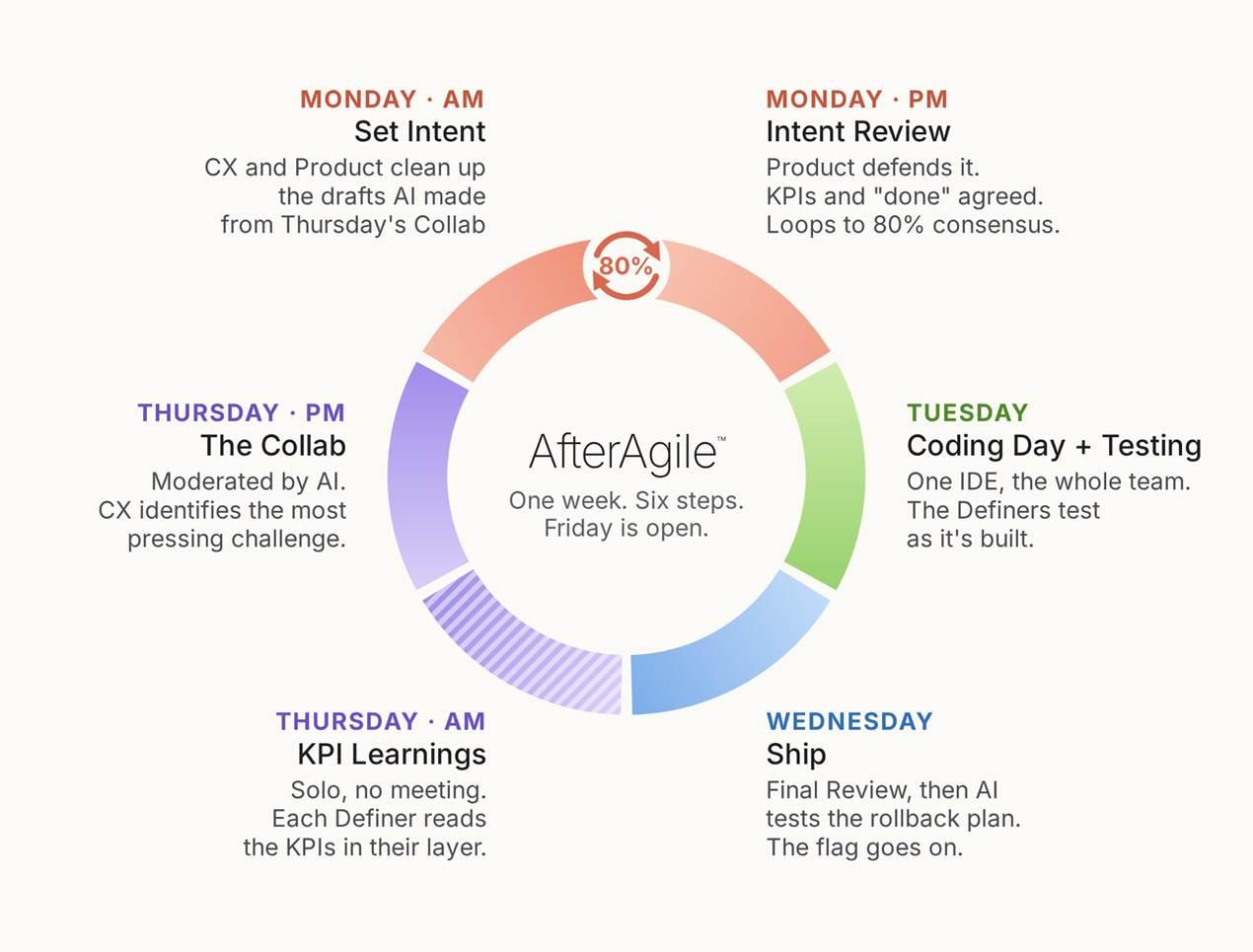
Monday: Set Intent and Intent Review. AI drafts the week’s Intent using customer signals — support tickets, usage data, behavioral patterns. Customer Experience (CX) and Product refine the direction. Product then presents and defends it to stakeholders until the group reaches 80 percent consensus. Nothing gets built until there is shared agreement on why it deserves to be built.
Tuesday: Build and Test Together. CX, Product, User Experience (UX), and Engineering work side by side in a shared AI-native workspace. Testing happens throughout, not after. The people who defined what “right” looks like are in the room while the work takes shape, catching misalignment early instead of filing tickets about it later.
Wednesday: Ship with a Safety Net. Following a Final Review in the morning, the team releases the change to a portion of customers behind a feature flag. A tested rollback plan is ready before the flag goes live. If something breaks, the team reverses it the same day — not three sprints from now.
Thursday: Learn and Redirect. Each owner — CX, Product, UX, Engineering — reviews KPIs within their area of responsibility. No group meeting for this step; each person looks at what their
layer of the work actually produced. In the afternoon, an AI-moderated session called The Collab brings the team together to interpret real customer behavior and shape the following Monday’s Intent.
Friday: Protected Space. Friday is deliberately unstructured. No ceremonies, no catch-up work, no fifth day of sprinting. AfterAgile™ protects it as time for teams to think, explore side projects, address technical debt, or step back entirely. The value is not what gets done on Friday — it is what Monday through Thursday can accomplish when people have room to breathe.
Together, the six steps create something traditional Agile never had: a weekly closed loop where customer needs drive decisions, teams build and test collaboratively, and real-world results inform what happens next — all within the same seven days.
One Team, Shared Accountability
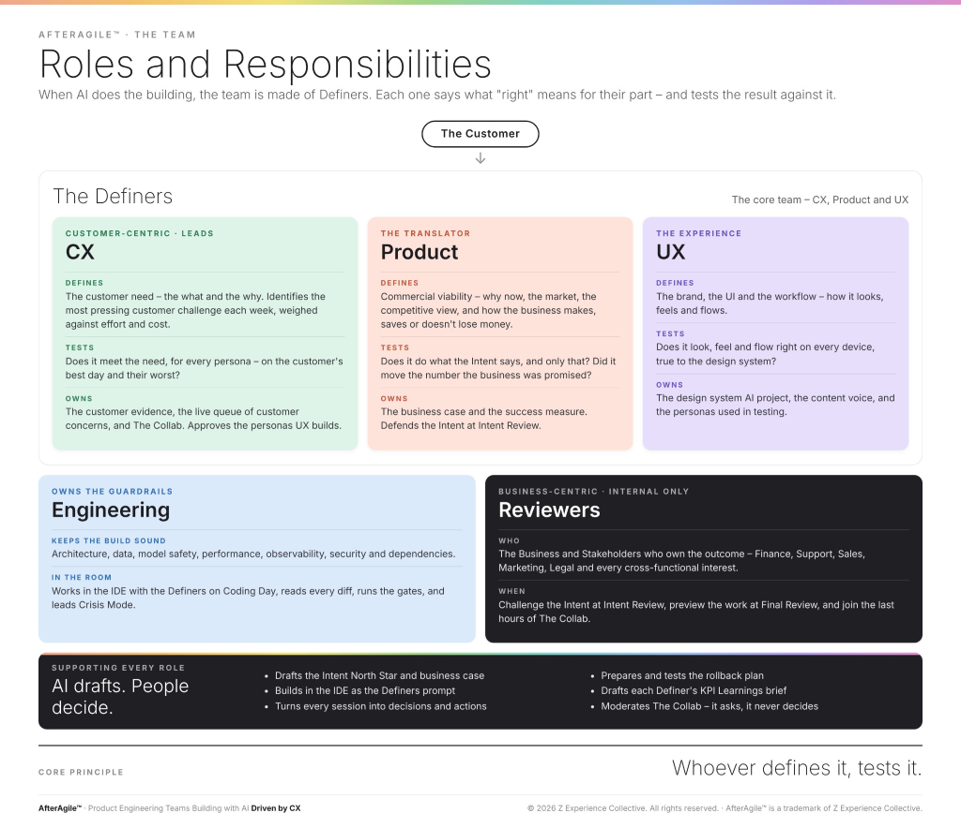
The principle at the heart of AfterAgile™ is simple: whoever defines it, tests it. The people who decide what “right” means are the same people who determine whether the result got there.
● CX defines the customer’s needs.
● Product establishes the business case and success measures.
● UX shapes the brand, interface, and workflow.
● Engineering maintains the guardrails that keep development safe.
There is no separate QA handoff. No backlog of tickets waiting for someone else to review. No end-of-sprint retrospective where the team finally discusses what happened two weeks ago.
Every role stays accountable from intent to outcome within the same seven days.
This is where AfterAgile™ diverges most sharply from traditional Agile. Agile distributed responsibility across specialized stages — planning, development, testing, review — with handoffs between each one. That structure made sense when building was slow and coordination was the challenge. But when AI collapses development timelines, those handoffs become the slowest part of the process.
“In a traditional Agile setup, a team can ship three features in a week and have no idea which one moved a metric,” Sieber said. “AfterAgile™ connects every feature back to a customer signal and measures it before the week is out. That changes what teams pay attention to.”
A Practical Path Forward
Z Experience Collective has made the complete AfterAgile™ playbook available at no cost. The 84-page resource covers the underlying model, weekly practices, team roles, engineering guardrails, AI safety protocols, a one-week pilot plan, and a full business case. Organizations can use the framework independently or work with Z Experience Collective, beginning with a one-week pilot or pursuing a broader transition for an existing product.
The company is also preparing two additional offerings to extend the framework beyond the written methodology:
1. The Dashboard is a planned SaaS product launching Q1 2027. It will provide a single live view where aggregate inputs are displayed and AI source is captured, replacing the traditional backlog board and ticket queue. Instead of managing work through lists of tickets, teams will see their week’s Intent, progress, and results in one place.
2. AfterAgile™ Certification is planned for later this year, designed for practitioners working across CX, Product, UX, and Engineering who want to bring the method into their organizations with formal training.
The playbook’s free availability gives organizations an opportunity to evaluate the approach before committing to any operational change — and reflects Z Experience Collective’s belief that the framework and methodology should be accessible to any team exploring how AI changes their development practices.
Building Smarter, Not Just Faster
The broader argument behind AfterAgile™ is that faster development should support better decisions, not replace them. AI can help teams produce software at unprecedented speed, but customer understanding, business judgment, and responsible engineering remain essential to product quality.
Traditional Agile helped teams coordinate. AfterAgile™ helps them decide. By creating a weekly rhythm around intent, collaboration, controlled shipping, and measurable learning, it offers organizations a way to connect the speed AI provides with the customer-centered outcomes that determine whether speed was worth anything at all.
The method is a structured alternative for organizations that recognize a familiar problem: their teams are shipping more than ever, but they are less certain than ever that they are shipping the right things.
Those interested in exploring AfterAgile™ can download the free playbook at zexperiencecollective.com/afteragile, email hello@zexperiencecollective.com, or schedule an exploratory call at +1 619 374 6555 to discuss a pilot or a broader transition.
About Z Experience Collective
Z Experience Collective is a San Diego-based customer-centered consultancy co-founded by Shannon Sieber, CEO, and Michael ZeMans, President. Its offerings — AfterAgile™ and Holistic CX™ — help organizations put customers at the center of how products, services and processes are developed. Because fragmented teams can’t deliver a unified customer experience.
Sieber brings 20 years of experience in product, UX, and customer experience across healthtech, fintech, e-commerce, and telecommunications, and holds six health tech patents. ZeMans, a 2005 Webby Award winner, brings expertise in digital transformation (DX), user experience (UX), and customer experience (CX), specializing in change management transformation.
AfterAgile™ and Holistic CX™ are trademarks of Z Experience Collective.
Learn more at zexperiencecollective.com.
Biz Weekly Contributor
Covers business, technology, entrepreneurship, and the changing digital landscape.
This article features partner, contributor, or branded content from a third party. Members of the Biz Weekly editorial staff were not involved in the creation of this content. All views and opinions are those of the contributor alone.