Reflective Solo-Auditing: A New Framework for Examining Ethical Accountability in Game Production

A research framework examines how creative decisions, production constraints, and their consequences shape the ethical dimensions of completed games.
A finished video game reflects more than creative vision and technical execution. Behind its mechanics, accessibility, monetization, and visual design are decisions shaped by available resources, production constraints, and competing priorities. Understanding these decisions can reveal important questions about ethical accountability in game development.
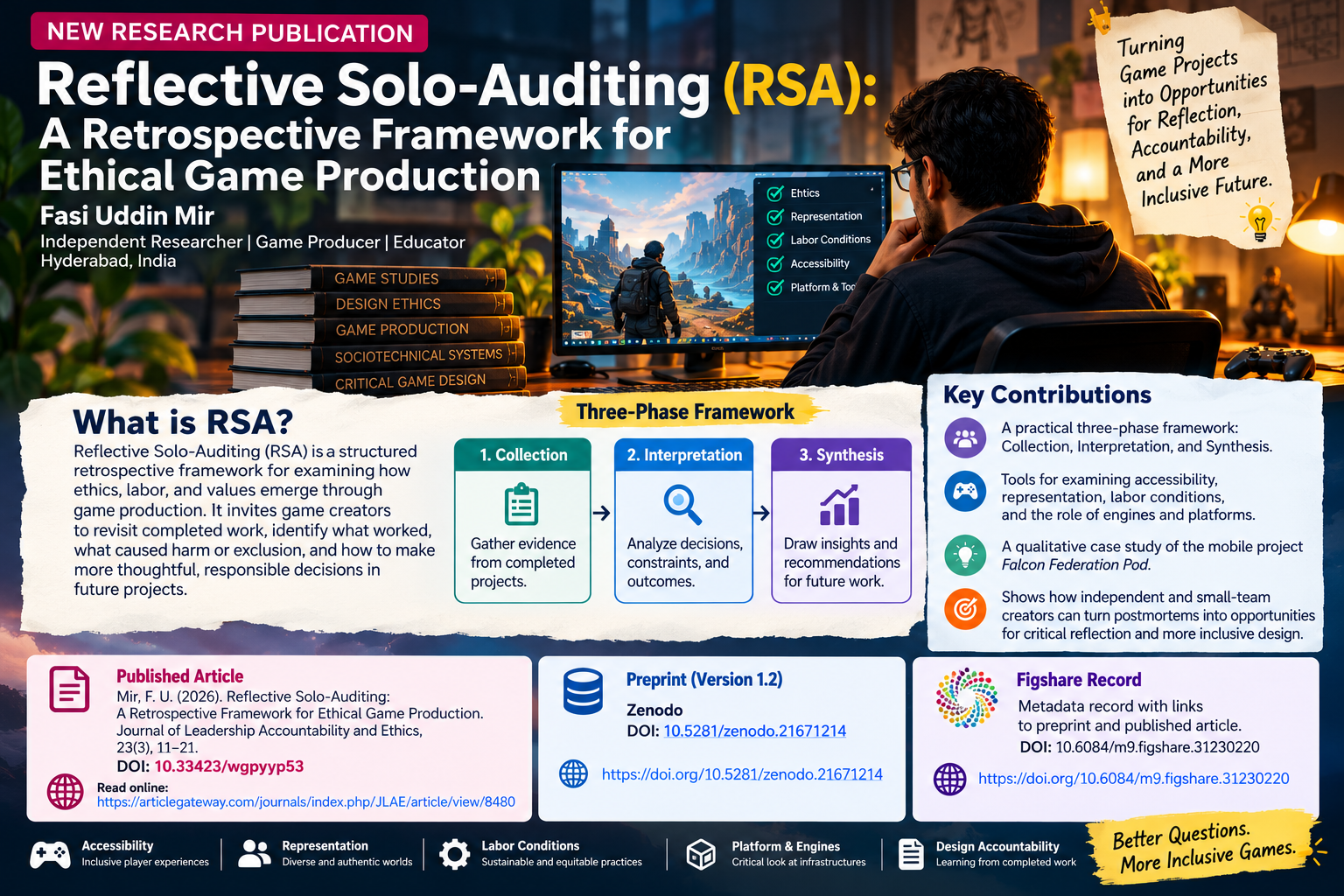
This is the focus of research by Fasi Uddin Mir, an independent researcher in critical game design based in Hyderabad, India. His paper, "Reflective Solo-Auditing: A Retrospective Framework for Ethical Game Production," was published in the Journal of Leadership, Accountability and Ethics, Volume 23, Issue 3 (2026), pages 11–21.
The research introduces Reflective Solo-Auditing (RSA), a practice-based framework for examining ethical accountability through the retrospective analysis of completed game-production processes. It considers not only what developers intended to achieve but also how practical constraints influenced their decisions and what consequences followed. The study integrates autoethnographic reflection with critical design research, treating the completed production process as a site for systematic methodological inquiry.
Looking Beyond the Finished Game
Ethical discussions in game development often focus on design principles, player experiences, and decisions made before or during production. However, the development process itself can reveal important aspects of accountability.
Accessibility, labor practices, monetization, and cultural representation, for example, can be influenced by technical limitations, economic conditions, platform requirements, and available resources. These circumstances may create tensions between a developer's original intentions and what can realistically be implemented.
RSA addresses this gap by treating completed production processes as subjects for structured ethical examination. Through documented evidence and critical reflection, the framework offers a way to revisit past decisions and understand how values, assumptions, and constraints influenced development.
Three Phases of Reflective Solo-Auditing
RSA follows three analytical phases: Collection, Interpretation, and Synthesis. Together, they provide a structured process for examining production experiences.
Collection establishes the evidence base by gathering relevant project documentation, production records, design decisions, and other materials that help reconstruct how a game was developed.
Interpretation examines this evidence critically, considering why decisions were made, which constraints influenced them, and how technical, economic, institutional, or infrastructural conditions shaped the available choices.
Synthesis brings the observations together to identify relationships, recurring patterns, ethical tensions, and lessons that may inform future development practices.
These phases are supported by four evaluative dimensions that guide the examination of individual decisions.
The three phases organize the process of inquiry, while the four evaluative dimensions operate as interconnected analytical lenses applied across those phases. They are complementary components of the framework rather than separate sequential steps.
Four Dimensions of Ethical Evaluation
The framework uses Intention, Constraint, Impact, and Reflection to examine the relationship between development choices and ethical accountability.
- Intention: Examines the original purpose, values, and reasoning behind a design or production decision.
- Constraint: Considers the technical, economic, institutional, and infrastructural conditions that influenced or limited the decision.
- Impact: Examines the consequences of decisions, including their implications for players, accessibility, representation, and development practices.
- Reflection: Revisits decisions after production to identify lessons, unresolved questions, and opportunities for improvement.
Together, these dimensions encourage developers and researchers to look beyond whether a decision achieved its immediate objective. They provide a way to consider the circumstances behind it and its wider implications. RSA is therefore intended as a structured approach to ethical inquiry rather than a simple compliance checklist.
Falcon Federation Pod: Putting the Framework into Practice
Mir developed and examined RSA through a retrospective case study of Falcon Federation Pod, an independently developed mobile game completed during his graduate studies at the University of Advancing Technology.
The project provided a practical context for exploring how the framework could be applied to an actual production process. Through project documentation and representative decision nodes, the study examines ethical considerations involving accessibility, labor, monetization, platform mediation, and cultural representation.
Rather than evaluating the game exclusively as a finished product, the research revisits the decisions and conditions that shaped its development. This retrospective approach makes it possible to examine how creative intentions interacted with production realities and consider implications that may not have been immediately apparent during development.
The case study serves as a situated examination of RSA, not proof of universal validation. Its purpose is to demonstrate and explore the framework within a specific production context.
Connecting Practical Experience with Research
Mir's interest in RSA connects his experience in game production with broader questions in critical game design, design ethics, and reflective practice.
His background in game development and production provides practical context for examining the decisions, compromises, and working conditions that influence creative projects. His research extends this perspective by exploring how completed production experiences can become material for systematic ethical inquiry.
This connection also makes the framework relevant beyond independent developers. Game studios and production teams can consider how documenting decisions and revisiting project constraints may strengthen internal reflection. Educators and researchers may find its methodology relevant to discussions of design ethics, professional accountability, and practice-based learning. Technology professionals can also engage with its broader questions about how technical and organizational decisions affect people.
Recognizing the Study's Limitations
An important qualification is that the research examines a single retrospective case study. While Falcon Federation Pod provides a specific context for developing and exploring RSA, one project cannot establish how the framework applies across different games, development teams, organizational structures, or production environments.
Further research is necessary to examine the methodology across additional projects and collaborative settings. Such investigations could help determine how RSA might be adapted, refined, and applied in different circumstances.
Acknowledging this limitation establishes a realistic scope for the research while identifying opportunities for continued investigation.
Making Completed Projects a Source of Ethical Learning
The publication of "Reflective Solo-Auditing: A Retrospective Framework for Ethical Game Production" contributes a practice-based perspective to discussions about accountability and responsible decision-making in game development.
Its central proposition is that understanding a game's ethical dimensions requires looking beyond the finished experience. The decisions, constraints, and assumptions behind its production also deserve examination.
Through its three analytical phases and four evaluative dimensions, RSA offers a structured approach to that examination. By connecting practical experience with critical reflection, the framework creates an opportunity to learn from completed projects and bring those insights into future research and development practices.
Explore the Research:
- Published Article – Journal of Leadership, Accountability and Ethics
- Reflective Solo-Auditing: A Retrospective Framework for Ethical Game Production
- Earlier Zenodo preprint (Version 1.2)
Key Takeaway for Industry Leadership
For studio leaders, game producers, and creative directors, Reflective Solo-Auditing offers a structured approach to revisiting completed projects as sources of ethical learning. By examining the intentions behind decisions, the constraints that shaped them, their observable consequences, and the knowledge gained through reflection, production teams can develop a more systematic understanding of their creative and organizational practices.
Rather than prescribing universal solutions, RSA encourages informed critical inquiry that can help guide future design, production, and educational practices.
Biz Weekly Contributor
Covers business, technology, entrepreneurship, and the changing digital landscape.
This article features partner, contributor, or branded content from a third party. Members of the Biz Weekly editorial staff were not involved in the creation of this content. All views and opinions are those of the contributor alone.