A unified sports intelligence system linking data, models, simulations, and AI to improve research transparency and analysis.
A prediction can take seconds to produce, but understanding the evidence, methodology, and history behind it requires a much deeper analytical process.
That challenge sits at the center of ATLAS, an intelligence architecture being developed by Manny’s Variety to connect specialized models, simulations, sports data, research, historical results, and AI-assisted analysis within a common technology environment.
Rather than functioning as another standalone chatbot or prediction tool, ATLAS is being developed as an underlying system for organizing and connecting different forms of sports intelligence. Sports serve as its initial proving ground, giving the technology an environment where information changes constantly and analytical decisions can be evaluated against measurable outcomes.
The idea reflects a broader question facing modern sports technology: How can increasingly complex information become easier to understand, evaluate, and research?
Bringing Fragmented Sports Information Together
Sports analysis often involves information spread across multiple systems. Player statistics may exist separately from team data, research may be stored elsewhere, and historical results may require another process to evaluate.
ATLAS is designed to connect those layers.
A sport-specific model can examine a particular situation while simulations can explore possible scenarios. Player and team information can provide context, while historical records can help researchers examine how previous methodologies performed.
The purpose is not simply to produce an answer. It is to preserve the information surrounding that answer so the analytical process can be examined later.
Manny’s Variety describes its existing technology ecosystem as incorporating statistical modeling, simulations, structured sports information, published analysis, and historical performance tracking. ATLAS is intended to provide the architecture connecting these capabilities while allowing different methodologies to remain distinct.
Different sports require different analytical approaches. ATLAS is therefore being developed to connect specialized methodologies rather than treating every analytical problem as identical.
Turning Predictions Into Research Records
One of the central concepts behind ATLAS is preserving an analytical record.
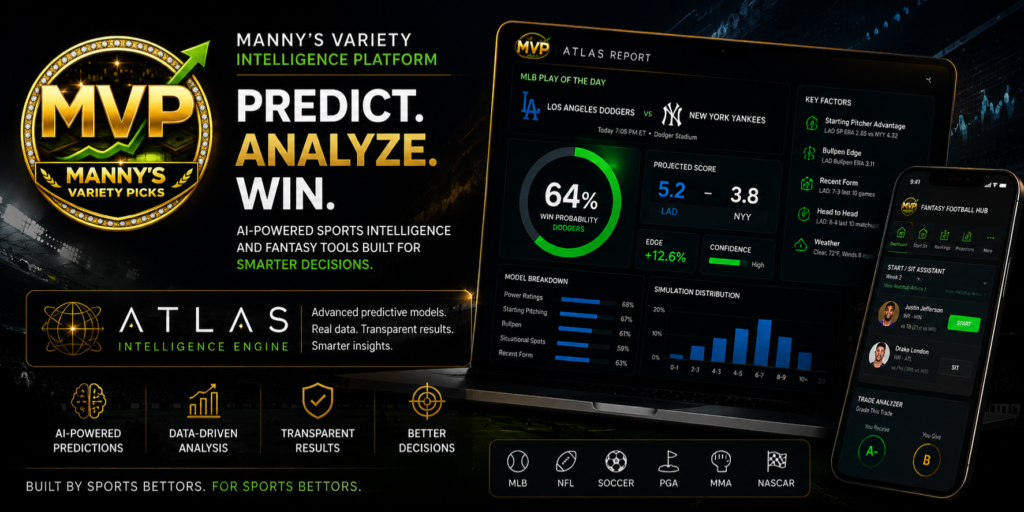
An ATLAS Report is being developed to organize information surrounding an analytical output. Depending on the application, that record can include the original prediction, supporting evidence, methodology, relevant context, model information, counterarguments, final results, and historical performance.
The underlying philosophy is straightforward: an analytical result should remain available for examination after an event has ended.
Historical records can help researchers study which methodologies have performed consistently, where they have struggled, how large the sample is, and whether changes in methodology affected outcomes.
Importantly, historical performance is not presented as a guarantee of future results. Instead, past outcomes become part of a research record that can help inform evaluation and validation.
“We built ATLAS because I never wanted the answer to just be ‘trust the model,’” said Manny, Founder and CEO of Manny’s Variety. “I want to know what the model saw, what evidence supported it, what happened afterward, and whether that methodology actually earned the right to be trusted.”
That philosophy places transparency at the center of the technology’s development.
Why The Architecture Matters
The value of ATLAS is not simply the amount of information it can contain. Its potential comes from the relationships between different types of information.
A player model can contribute to sports research, while player and team data can provide context for other analytical applications. Historical results can help evaluate methodologies, while research developed for one application may provide useful context for another where the underlying data and methodology are relevant.
ATLAS is not being presented as an autonomous system in which every result automatically changes every other application. Instead, the architecture is designed to create a common foundation where data, research, models, and analytical capabilities can be connected and reused when appropriate.
That makes the platform less about creating one universal model and more about developing an organized environment for multiple forms of intelligence.
Fantasy Football Offers Another Test Case
Fantasy football provides one example of how the architecture can support a different sports research environment.
The MVP Fantasy Football Hub is being developed around capabilities including player rankings, projections, draft preparation, roster analysis, trade research, matchup analysis, waiver research, and weekly lineup analysis.
These applications require information from several areas. Player performance can inform rankings and projections, team circumstances can provide context for matchup research, and historical performance can help researchers understand longer-term trends.
Fantasy football also presents a demanding analytical environment because conditions change throughout a season. Injuries, player performance, team strategy, schedules, and other variables can alter the information available from week to week.
For ATLAS, that creates an opportunity to demonstrate how an intelligence architecture can organize changing information while preserving the reasoning and evidence behind analytical outputs.
AI Is One Layer, Not The Entire System
Artificial intelligence is an important component of ATLAS, but it is only one part of the broader architecture.
The system is being developed around specialized statistical models, structured sports data, simulations, historical validation, methodology tracking, research, player and team context, and AI-assisted interpretation.
That distinction becomes increasingly relevant as AI becomes more common throughout sports technology. Connecting a language model to a database can create an interface capable of answering questions, but a broader analytical system requires evidence, structured information, specialized methodologies, and historical evaluation.
ATLAS is being developed around the idea that AI becomes more useful when it operates alongside those components.
Its role can include helping users navigate complex information and interpret research, while underlying models and data provide the analytical foundation. AI is therefore positioned as another tool within the research process rather than a replacement for it.
A Technology Shaped By Experience
The development of ATLAS also reflects the professional experience of Manny, whose background includes a Master’s degree in Casino Operations, eight years in resort and casino management, large-scale operational experience, work with Amazon, four AWS certifications covering areas of cloud and technology, and a long-standing interest in sports.
That combination of operational experience and technology training has influenced the way the platform approaches information.
Rather than treating an analytical output as the final product, the development philosophy emphasizes understanding the process that produced it.
The question is not simply whether a system can generate an answer. It is whether researchers can examine how that answer was developed, what evidence informed it, and how the methodology performed over time.
“We’re not trying to create technology that asks people to trust an unexplained answer,” Manny said. “We want the research, the evidence, and the results to stay connected so people can understand what the system produced and why.”
Recognition And Continued Development
Manny’s Variety Picks was named Best AI Sports Analytics Platform in the United States of 2026 by Best of Best Review, recognizing work involving predictive modeling, sports data, AI-assisted research, and historical performance tracking.
The recognition forms part of a broader development story, but ATLAS remains a technology architecture that is continuing to evolve.
Current elements of the Manny’s Variety ecosystem include AI-assisted sports analysis, simulations, structured data, published analytical outputs, and performance tracking. Other elements of the broader ATLAS architecture, including expanded reporting, fantasy applications, and additional research capabilities, remain under development.
ATLAS is not being presented as a finished system capable of solving every analytical problem. It represents an evolving infrastructure designed to make sports information more connected, measurable, and accessible for research.
From Sports Intelligence To A Broader Idea
Sports provide a practical environment for developing this type of technology because the field produces large volumes of information while outcomes can ultimately be compared with measurable results.
That makes sports a useful testing ground for an architecture focused on evidence, methodology, and historical analysis.
The broader concept could eventually extend beyond sports, although those possibilities remain future opportunities rather than completed applications. For now, the focus remains on developing the underlying architecture and determining where connected data, research, models, simulations, and AI-assisted interpretation can provide meaningful value.
At its core, ATLAS reflects a simple philosophy: complex analytical systems become more useful when the information behind their outputs remains visible and connected.
For Manny’s Variety, the company is developing the broader ecosystem. ATLAS represents the intelligence layer designed to connect it.
Sports are the initial proving ground. Research provides the foundation. Historical records create a way to evaluate methodologies. AI adds another layer of interpretation.
The larger objective is to build technology that helps people understand where analytical information came from, how it was evaluated, and what can be learned from it over time.
To explore the technology and current Manny’s Variety ecosystem, visit Manny’s Variety. Readers can also follow Manny’s Variety on X and Instagram for updates as ATLAS and its applications continue to develop.
Disclaimer:
This article is for informational purposes only and is not intended to promote, encourage, or provide professional advice related to sports betting, gambling, or wagering activities. Always consult a qualified professional or trusted authority before engaging in any activities related to sports betting or gambling, especially if doing so may have legal, financial, or personal consequences. The author and publisher are not responsible for any losses, damages, or outcomes resulting from the use or reliance on the information provided.