Cart Rescue AI helps DTC brands improve Shopify abandoned cart recovery with real-time SMS conversations that resolve buyer hesitation at checkout.
A shopper reaches checkout, pauses, and hesitates. The product is right. The timing is right. The intent is there. Yet one unanswered question about shipping, sizing, returns, or delivery is enough to stop the order.
For years, most e-commerce brands have responded too late, sending reminder emails or SMS messages long after the customer has moved on. Cart Rescue AI was built around a sharper idea: the real problem is not abandonment alone. It’s silence during the buying decision.
From Reminder Problem to Decision Problem
Cart Rescue AI enters a market that has long treated Shopify cart abandonment as a follow-up issue. The standard playbook is familiar: wait, send an email, follow with SMS, offer a discount.
Sometimes that works. Often, it doesn’t.
By the time the message arrives, urgency has faded, attention has shifted, and the sale is gone.
Cart Rescue AI focuses on the decision window, the brief moment when a shopper is still willing to buy but needs reassurance to proceed. Instead of chasing the customer later, the platform starts a real-time SMS conversation the moment hesitation appears.
Greg Scott puts it simply:
“Most brands treat cart abandonment like a reminder problem. We see it as a decision problem. When someone pauses at checkout, they usually haven’t decided not to buy, they just need a question answered.”
That shift changes the economics of e-commerce growth. Recover more from existing traffic, and you improve return on ad spend without increasing acquisition costs.
Why the Old Playbook Is Losing Power
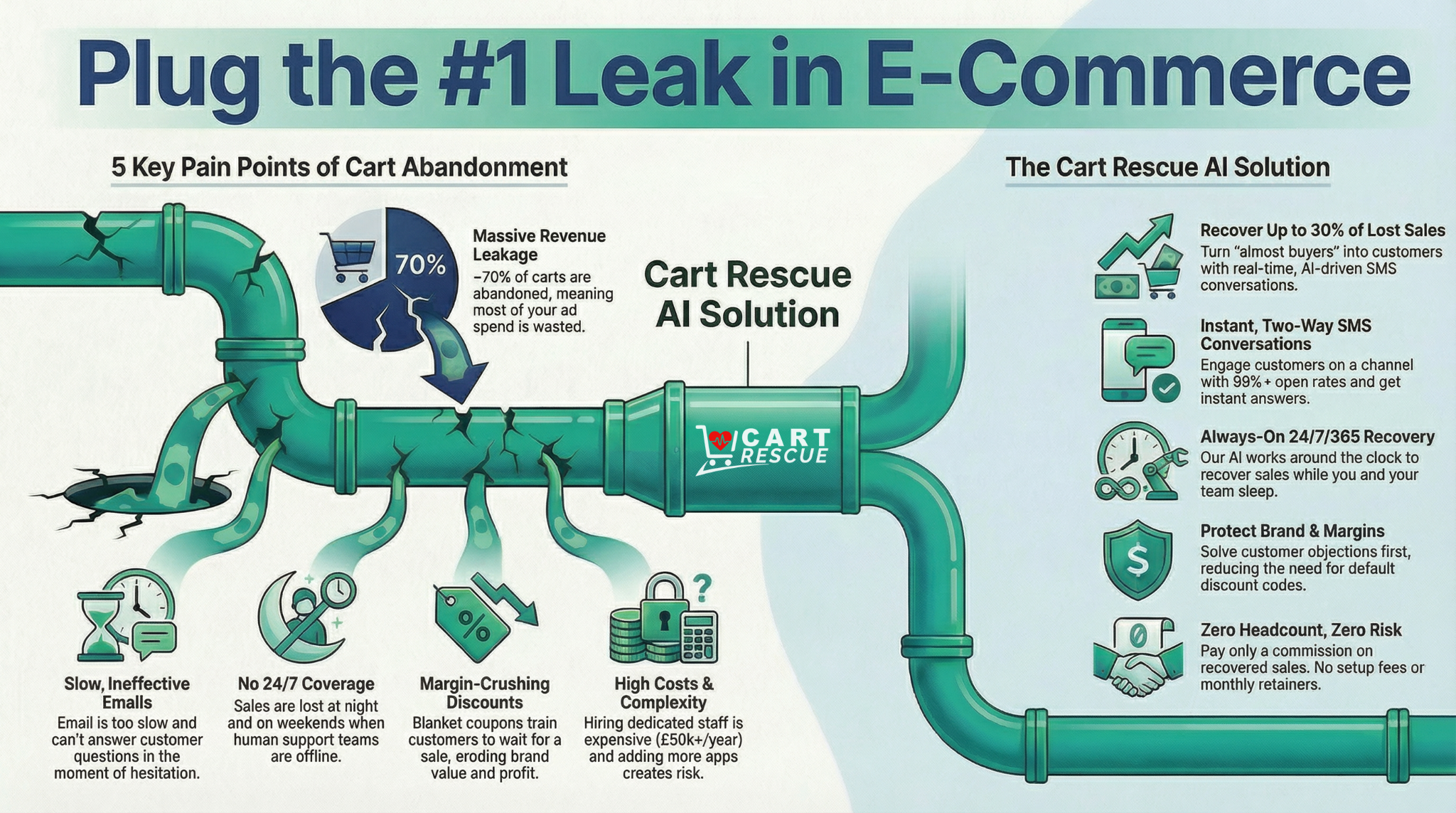
Across e-commerce, roughly 70 percent of carts are abandoned. Many brands still rely on delayed systems that assume the customer simply forgot.
Cart Rescue AI is built on a different view. Many buyers do not leave because they lost interest. They leave because they hit friction.
That friction is usually simple.
Will it arrive on time?
Does it fit?
What if it doesn’t work?
These are not objections. They are unanswered decisions.
If a shopper has to leave checkout to find answers, the momentum breaks. And once momentum breaks, conversions drop.
As Fiona Scott explains:
“The biggest revenue leak in e-commerce isn’t bad traffic or poor ads. It’s silence during the moment a customer is deciding whether to buy.”
Modern shoppers expect instant answers. In that environment, delayed reminders feel outdated. Real-time conversation feels natural.
A New Category in E-Commerce Growth
Cart Rescue AI describes its approach as real-time checkout recovery.
It is not a replacement for existing tools. It is a new layer that sits between automated campaigns and human support, stepping in at the exact moment uncertainty appears.
The platform operates externally via the Shopify API, meaning brands can add it without changing their checkout or disrupting tools like Klaviyo. It runs continuously, engaging shoppers in real time without requiring additional staff.
The business model reflects that positioning. Cart Rescue AI charges on performance rather than fixed fees. If it does not recover revenue, the brand does not pay.
Built for a Tougher E-Commerce Climate
E-commerce has become more demanding. Advertising costs are higher. Competition is tighter. Margins are under pressure.
For many brands, growth no longer comes from buying more traffic. It comes from improving Shopify conversion rate optimisation by converting more of the traffic already reaching checkout.
Cart Rescue AI is designed for that shift. The company says brands can typically recover 20 to 30 percent of abandoned carts by resolving hesitation in real time.
More important than the number is the principle behind it.
This isn’t about sending more messages. It’s about responding faster.
The Human Insight Behind the Technology
At its core, the insight is simple.
People buy when they feel confident.
They hesitate when they feel uncertain.
Cart Rescue AI addresses that uncertainty at the exact moment it appears. Instead of relying on discounts or repeated reminders, it provides clarity when the decision is still open.
That gives the platform a distinct role in the market. It is not just another automation tool. It acts more like a digital sales assistant at checkout, helping shoppers complete their purchase decisions without adding friction.
The broader takeaway for Shopify founders is clear:
Not every growth problem is a traffic problem.
Often, it is a response-time problem.
And sometimes, the missing ingredient is not more marketing, but a faster answer.
Explore More About Cart Rescue AI
Most Shopify stores don’t realise how much revenue is lost in the decision window.
Explore how much recoverable revenue may already be sitting inside your checkout.
Connect with Cart Rescue AI and Greg Scott on LinkedIn.