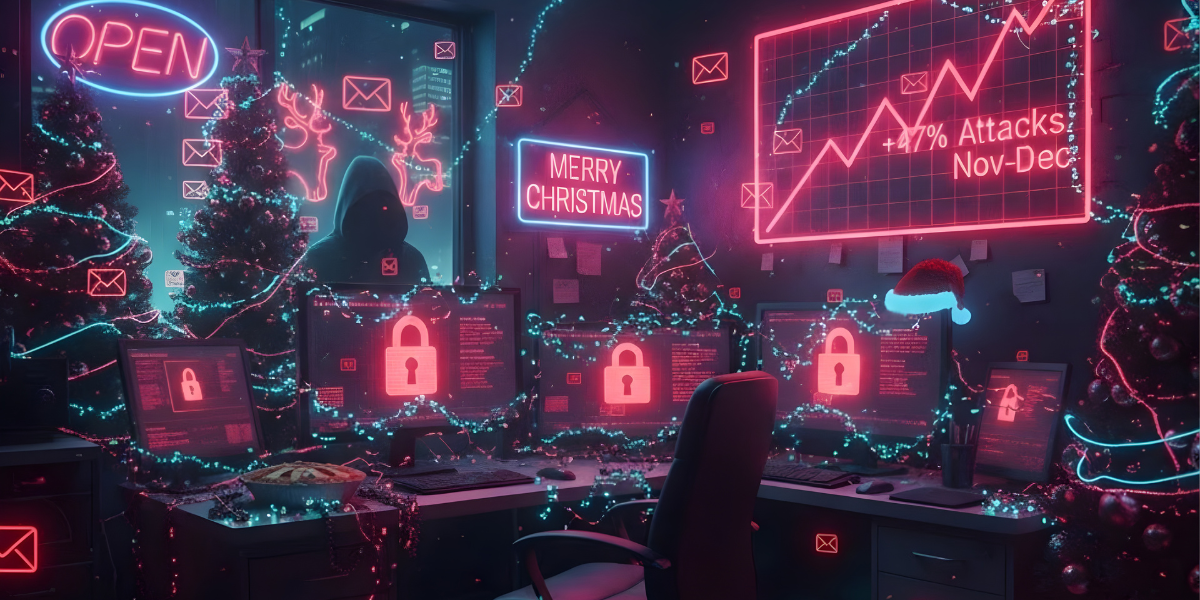
Every year, the holiday season brings more than celebrations. It brings the single most dangerous stretch of time for small and midsize businesses in America.
Ransomware spikes.
Email scams explode.
Credential theft surges.
Employees are distracted.
IT teams are understaffed.
Leaders are traveling.
And cybercriminals—foreign, domestic, and opportunistic—know it.
According to the FBI, cybercrime complaints jump by more than 30% between Thanksgiving and New Year’s, with ransomware attacks increasing by over 70% during the final months of the year. CrowdStrike reported that in recent years, holiday periods have seen active exploitation attempts every 7 minutes.
Major insurers like Coalition consistently warn that December is now the highest-loss month of the year for cyber claims.
And for small businesses—the underdogs of our economy—the costs are devastating.
Three out of four SMBs were hit by a cyberattack in the last year, and 60% shut down within six months of the incident.
But why is this happening? And why the holidays?
To find out, we spoke with George Hyek, founder of TRINSEC 7—a company built specifically to protect small businesses from advanced threats once reserved only for the nation’s highest-value targets.
His answer is blunt:
“Hackers hunt small businesses because they’re easy targets—and during the holidays, they’re the easiest they’ll ever be.”
Why Holiday Attacks Are Increasing
Hyek spent his career hunting threats—starting in local law enforcement and later in federal law enforcement, counterintelligence, and special operations support. He watched threat actors evolve from simple burglars to state-backed cyber operators.
And he watched small American businesses get caught in the middle.
“When the holidays hit,” he says, “every vulnerability gets amplified. Skeleton staffing, distracted employees, rushed year-end operations—it’s the perfect storm.”
He breaks it down into three core risks:
1. Staffing Drops, Workloads Spike
IT teams take time off. MSPs reduce support hours. Employees are multitasking or working remotely. Meanwhile, cybercriminals operate 24/7—especially when no one else is watching.
Microsoft’s Digital Defense Report noted that attackers intentionally launch phishing and ransomware campaigns during holiday weekends for precisely this reason.
2. Social Engineering Explodes
Scams disguised as:
- holiday shipping notices
- year-end invoices
- payroll updates
- charity requests
- travel confirmations
…lead to a dramatic seasonal rise in compromised accounts.
The FTC reports a 40% increase in phishing attempts in the final quarter of each year.
3. Foreign Adversaries Exploit the “Off-Hours”
Hyek explains that China, Russia, Iran, and North Korea intentionally target small businesses because they’re softer entry points into broader U.S. infrastructure.
“It’s not personal,” he says. “It’s strategic. If they can compromise enough small businesses, they can disrupt entire regions or industries later.”
Holiday periods—when response times slow—give them maximum opportunity to move quietly and deeply.
Why SMBs Are Hit Hardest
“Hackers hunt small businesses—3 out of 4 got hit last year and 60% went out of business within 6 months.”
Small businesses face all the same threats as large organizations but lack:
- a security team
- monitoring tools
- response capability
- compliance structure
- intelligence support
- vendor coordination
- budget for enterprise protection
Hyek puts it this way:
“Big threats hunt small businesses because they’re easy targets, but building real security in-house is too expensive.”
So during holiday spikes, SMBs aren’t just vulnerable—they’re exposed.
Where Security Fails During the Holidays
Hyek has seen this play out firsthand and describes the failure pattern clearly:
Multiple vendors, zero security.
“You’ve got a camera company, an MSP, an AI tool, a compliance auditor… and none of them work together. When something breaks, everyone points fingers.”
“Ever feel like you have five security companies and zero security?”
Holiday attacks exploit exactly that fragmentation. A breach rarely starts where the CEO expects it. It begins in the cracks:
- a camera system with default passwords
- an outdated firewall configuration
- a misconfigured cloud setting
- an employee clicking a holiday-themed phishing email
- a vendor integration no one realized was exposed
When there’s no unified leader responsible for all layers of security, the business is one click away from catastrophe.
TRINSEC 7: Built for the Underdogs
Hyek founded TRINSEC 7 because, in his words:
“I was tired of walking into small businesses after the damage was already done.”
TRINSEC 7 fuses cyber, physical, AI, compliance, and intelligence into one cohesive security department—at a price small businesses can manage.
Your attached messaging hits this clearly:
“TRINSEC 7 becomes your entire security department. All Threats. One Partner.”
During holiday attack surges, that unified model becomes critical.
Hyek explains, “Instead of five vendors who won’t answer the phone on Christmas Eve, you call one number.”
It’s not a security tool—
It’s not a consultant—
It’s not a checklist—
It’s a full security program.
How TRINSEC 7 Protects Businesses During Holiday Surge
Hyek shared several ways TRINSEC 7 shields organizations during the season when attacks are most aggressive:
1. Real-time Monitoring and Rapid Response
Attacks detected early are easier to stop. Attacks that wait until after the new year are catastrophic.
2. Hardening Before High-Risk Windows
TRINSEC 7 identifies and closes vulnerabilities before holiday weeks arrive.
3. Holiday-Specific Training
Employees learn to spot seasonal phishing, invoice scams, and impersonation attempts.
4. Vendor and Tech Alignment
Your cameras, IT, cyber tools, and AI finally work in a single ecosystem.
5. Compliance and Insurance Readiness
Many SMBs don’t even meet cyber insurance requirements—TRINSEC 7 fixes that so companies aren’t left without coverage after an attack.
6. Grants and Funding Support
Some clients qualify for state or federal grants that cover their entire security overhaul—so we do the heavy lifting for them with those.
Why Holiday Protection Matters Now More Than Ever
The data is clear:
- Phishing increases up to 52% during the holidays (Darktrace).
- Ransomware groups launch up to 80% more attacks between November and January (NCC Group).
- Business email compromise rises sharply during year-end payroll changes (FBI).
- Remote-access attacks spike as businesses slow operations and reduce oversight.
The holidays aren’t just a peak attack season—they’re the most dangerous months of the year for small businesses.
A Final Word for CEOs
When asked what he wants business owners to understand as the holidays approach, Hyek says it simply:
“The threats don’t take time off. But you should be able to. That’s why we exist.”
TRINSEC 7 isn’t just protection—it’s peace of mind for America’s underdogs during the most dangerous time of the year.
Related Links: