How AI Automation Is Replacing Manual Processes for Small to Medium Size Businesses
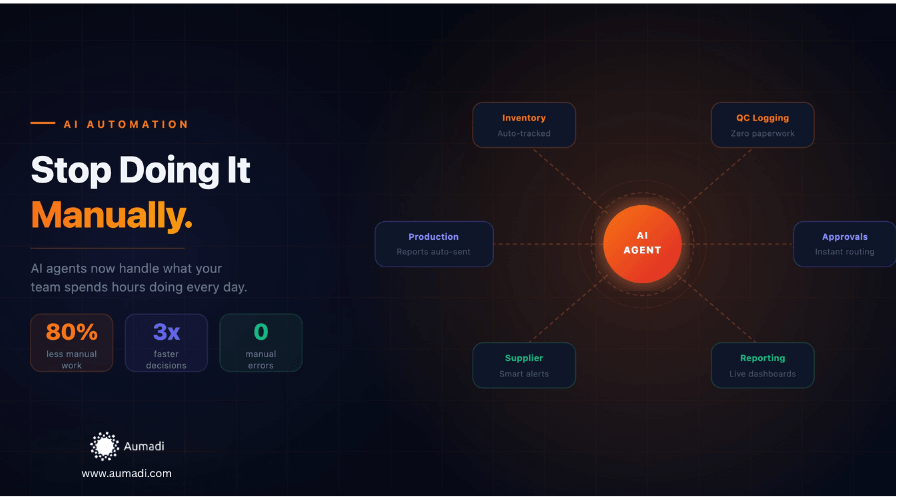
How AI automation helps mid size businesses replace manual workflows, reduce errors, save time, and scale operations efficiently.
In traditional businesses across the United States, many mid-size teams are still running critical operations on spreadsheets, manual data entry, and disconnected tools. Approvals happen over messaging apps. Receipts are reconciled by hand. Information is copied from one system to another.
Nothing is technically broken, yet everything moves slower than it should.
These workflows create delays, introduce errors, and quietly increase operational costs. As businesses grow, the inefficiencies become harder to ignore. What once felt manageable starts to limit speed, visibility, and decision-making.
This is not an isolated case. Across manufacturing and supply chain operations, teams continue to rely on fragmented systems to keep work moving. Data is entered multiple times. Approvals are delayed. Information gets lost between tools. The process works, but not efficiently.
The Shift Toward AI Automation
For years, the assumption was that only large technology companies could afford to automate these processes. Artificial intelligence and advanced workflows felt out of reach for mid-market businesses.
That assumption is no longer true.
AI agents and automated workflows are now accessible to companies that are not Google or Amazon. The tools have matured, and the barrier to entry has dropped. Businesses can now design systems that handle repetitive tasks, trigger actions, and manage decisions based on predefined logic.
Instead of relying on constant manual input, teams can shift to workflows that operate with oversight rather than intervention.
Where Aumadi Fits In
This is where Aumadi plays a key role.
Aumadi positions itself as a bridge between traditional business operations and modern automation. Rather than simply building applications, the company designs systems that think and act. Its focus is on helping small to mid size businesses transition from manual processes to structured, intelligent workflows.
The approach starts with understanding how a business operates today. Where are the delays. Where do errors occur. Which tasks are repeated daily.
From there, Aumadi designs workflows that replace manual steps with automated actions. These workflows are powered by AI agents that can manage approvals, track progress, and ensure that processes move forward without bottlenecks.
Case Study: Transforming A US-Based Supply Chain Operation
The impact becomes clear when looking at a recent project with a US-based supply chain company.
Before working with Aumadi, the business relied heavily on manual processes. Project tracking was handled through spreadsheets that required constant updates. Team members entered data by hand, often duplicating work across systems. Receipts were reconciled manually at the end of each week, consuming hours of effort and introducing frequent errors.
Approvals were another challenge. Managers relied on messaging apps or emails to review and approve requests. Messages were missed. Decisions were delayed. There was no clear record of who approved what and when. As the company grew, these inefficiencies became more visible and more costly.
The business knew it needed to improve but lacked a clear path forward. That is when it partnered with Aumadi.
Building Intelligent Workflows
Aumadi began by mapping the existing workflow in detail. Every step was analyzed and delay was documented for the first few weeks. This process revealed opportunities for automation that were not obvious at first glance.
Rather than replacing the entire system, Aumadi focused on the areas that would deliver the greatest impact. What followed was 6 weeks of development and deployment cycle.
The solution was an AI-driven workflow designed to handle key operational tasks. Automated triggers replaced manual updates. When a project reached a certain stage, the system updated records automatically. Data moved between systems without requiring manual entry.
An AI agent was introduced to manage approvals. Instead of relying on messaging apps, requests were routed through a structured workflow. The agent notified the appropriate person, tracked responses, and recorded decisions. If an approval was delayed, the system followed up automatically. This created accountability and reduced missed approvals.
Receipt reconciliation was also transformed. Instead of manual review, the system collected and matched data in real time. Discrepancies were flagged immediately, allowing the team to resolve issues before they escalated.
Measurable Results That Matter
The result was not just a faster process. It was a more reliable one.
The company saved 52 hours each week. Errors were significantly reduced. Team members no longer spent their time on repetitive tasks. Instead, they focused on higher value work that required judgment and decision-making.
The business moved faster, with greater confidence in its data and operations.
Why This Matters For Every Business
This example reflects a broader reality across small to medium businesses.
Manual processes may feel manageable, but they carry hidden costs. Time spent on repetitive work adds up. Errors create delays and require rework. Growth is limited when teams are focused on maintaining processes instead of improving them.
AI automation offers a practical path forward. It allows businesses to streamline operations without increasing headcount. It improves consistency and reduces reliance on manual input.
Most importantly, it enables teams to focus on work that drives real value.
Aumadi’s role in this shift is to make that transition achievable. By focusing on targeted workflows rather than full system overhauls, the company helps businesses see measurable improvements quickly.
A Practical Path Forward With Aumadi
The implications extend far beyond manufacturing. Any mid-market business with repetitive processes is likely facing similar inefficiencies.
Where there is repetition, there is an opportunity to improve.
As more companies recognize this, the question is no longer whether to automate, but how quickly they can begin.
Aumadi works with businesses to design and implement AI-driven workflows that replace manual operations with structured, reliable systems. The focus remains on outcomes that matter. Time saved. Errors reduced. Teams empowered to focus on higher-impact work.
For organizations still relying on spreadsheets and manual processes, the tools to improve are already available. The shift does not require a complete overhaul, but it does require a clear starting point.
To explore how AI automation can improve your operations, connect with Aumadi Technologies, LinkedIn, FlutterFlow Expert Profile and learn how intelligent workflows can transform the way your business runs.
Biz Weekly Contributor
Covers business, leadership, and entrepreneurship, highlighting emerging companies and the people behind them.
This article features partner, contributor, or branded content from a third party. Members of the Biz Weekly editorial staff were not involved in the creation of this content. All views and opinions are those of the contributor alone.