Bury It. Burn It. Recover It.
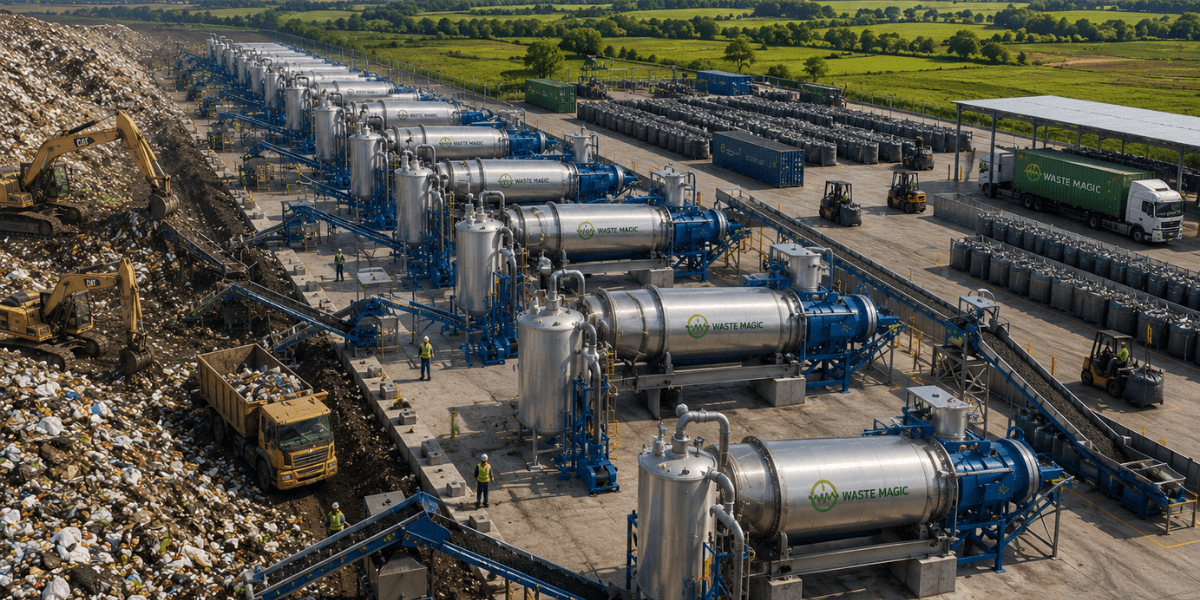
Waste Magic offers a new approach to waste, recovering valuable materials through modular technology instead of landfill or incineration.
Why the future of waste management is moving beyond incineration
For generations, humanity had one answer to waste:
Bury it.
Landfill solved an immediate problem, but the consequences became clear — methane emissions, contaminated leachate, enormous land requirements and valuable resources permanently buried.
So the world searched for a better solution.
Phase Two was: Burn it.
Waste-to-energy offered an alternative: reduce landfill volumes while recovering electricity and heat. For residual material that cannot practically be recycled, modern incineration still has a role.
But progress does not mean permanence.
“Incineration was an important step forward from landfill, but we shouldn't confuse an improvement with the final solution,” says Waste Magic CEO Bradley Bilbie. “If we can recover valuable material from waste instead of burning it, why keep building enormous furnaces designed to operate for another 30 years?”
The hidden complexity of burning waste
Waste-to-energy requires major capital investment, continuous waste supply, transport networks, emissions controls, wastewater and leachate treatment, ash management and environmental monitoring.
The waste does not disappear. Combustion produces energy, but also CO₂, bottom ash and toxic fly ash and pollution-control residues requiring specialised treatment and disposal, including landfill.
Real-world plants face recurring challenges: wet or poorly sorted waste reduces combustion efficiency; contaminants can damage equipment and cause lengthy shutdowns; leachate requires treatment; and emissions require sophisticated controls.
“Incinerators are a social responsibility, not an economic one,” Bilbie says. “They require very long lock-in contracts and often rely on government support, subsidies or favourable funding structures to make the financial model viable.”
The centralisation problem
Large waste-to-energy plants depend on enormous quantities of waste being transported to a central location. Waste is heavy and expensive to move, yet facilities require predictable throughput to operate efficiently and support long-term financing.
They also face intense public opposition, driven by concerns around emissions, potential health risks, truck movements and the impact of living near an incinerator.
Sweden illustrates another contradiction. Often presented as the global waste-to-energy success story, Sweden has around 7.1 million tonnes of annual energy-recovery capacity. In 2023 it imported around 1.7 million tonnes of waste for energy recovery, while industry analysis suggests imports could rise to 2–2.5 million tonnes within five years if available capacity is to remain filled.
“A truly circular economy should be trying to produce less waste, not worrying about finding enough waste to keep its infrastructure running,” Bilbie says. “When millions of tonnes of rubbish are moving between countries to keep incineration capacity utilised, you have to question whether the model itself has become the problem.”
Phase Three: Recover It
Waste Magic proposes a fundamentally different approach.
Its proprietary system is designed to process mixed, unsorted organic and carbon-based waste streams. Metals, glass, concrete and similar aggregates — which have their own recyclable value — are ideally separated before processing.
Suitable carbon-containing material is converted into recovered carbon-rich material and distilled water, inside a sealed processing system rather than through conventional combustion.
“Waste is not simply something to bury or burn,” says Waste Magic co-founder and inventor Dr Jamil Rima. “It contains carbon and other materials that still have value. Our technology was developed around recovering that value rather than destroying it through combustion.”
Instead of building enormous centralised plants and transporting waste to them, Waste Magic uses decentralised, modular equipment designed to go directly to existing waste locations — including transfer stations and landfill sites.
“Our philosophy is simple: don't bring the waste to the machine; bring the machine to the waste,” Bilbie says. “Recover the material, put it back into productive use and build capacity where it is actually needed. That's what a circular economy should look like.”
Biz Weekly Contributor
Covers business, technology, entrepreneurship, and the changing digital landscape.
This article features partner, contributor, or branded content from a third party. Members of the Biz Weekly editorial staff were not involved in the creation of this content. All views and opinions are those of the contributor alone.