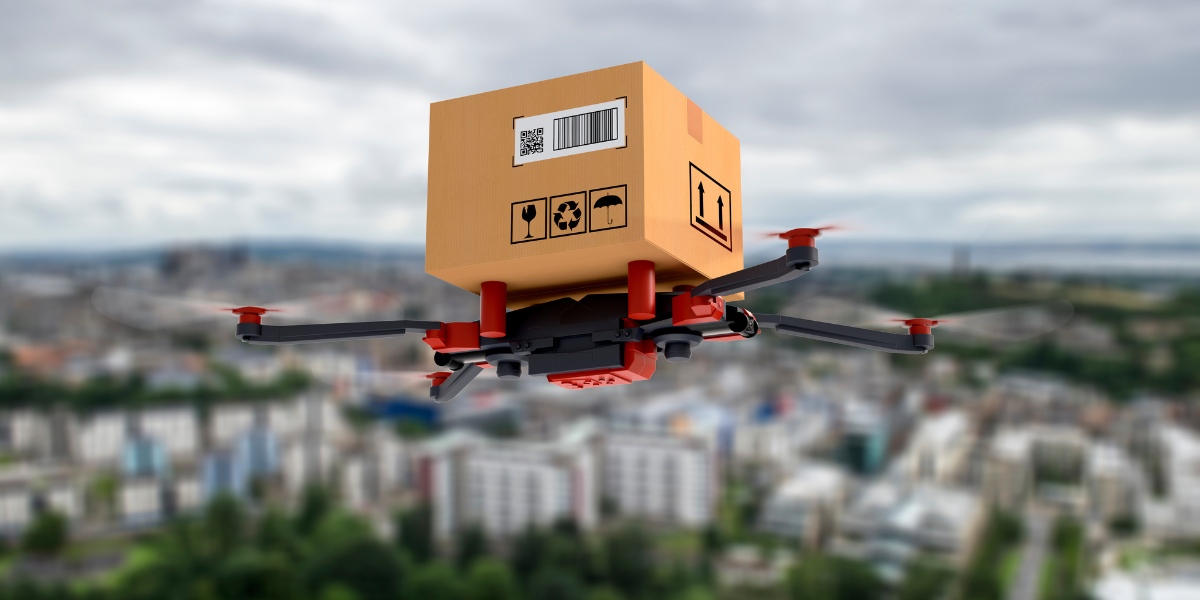
Uber announced a strategic partnership with autonomous-drone company Zipline Monday, expanding the technology company’s efforts to integrate autonomous delivery into its consumer marketplace.
The companies plan to begin Zipline drone deliveries through Uber Eats later in the year, initially in markets where Zipline already operates. The partners said they ultimately intend to expand into dozens of U.S. cities and target one million drone deliveries per day by the end of 2029.
Uber will also make a strategic investment in Zipline, although financial details were not disclosed.
Uber’s partnership-first strategy
The announcement reflects an increasingly important element of Uber’s technology strategy: working with specialized autonomous-technology companies rather than developing every system internally.
Zipline provides the aircraft, delivery network and operational expertise, while Uber contributes its consumer marketplace and Uber Eats infrastructure.
That division of responsibilities could allow both companies to pursue expansion more quickly than if either attempted to build the entire system independently.
TechCrunch reported that Uber has used a similar approach in autonomous transportation, partnering with outside technology providers while maintaining the customer-facing platform.
Drone delivery moves toward scale
Zipline has spent years developing autonomous delivery technology and said it operates across four continents, serving more than 5,000 hospitals and health facilities.
The company has also expanded into consumer and commercial logistics. Reuters reported that Zipline has completed more than two million deliveries and has worked with companies including Walmart and restaurant brands.
The Uber partnership gives that network a new route into mainstream consumer commerce.
Instead of requiring a customer to discover a specialized drone service, delivery can be presented within an existing Uber Eats ordering experience.
The economics of faster delivery
The business case centers partly on delivery speed.
Zipline said its technology is designed to deliver orders in approximately five to 10 minutes.
Faster delivery can influence customer satisfaction, merchant selection and the economics of last-mile logistics. Traditional delivery depends heavily on road congestion, driver availability and parking.
Autonomous aircraft could potentially reduce some of those constraints for appropriate orders.
However, drone delivery is not a universal replacement for conventional delivery. Aircraft have limitations involving payloads, range, weather, operating areas and infrastructure.
The companies’ expansion plans will therefore depend on how successfully the technology can be integrated into different urban environments.
A major technology-business intersection
The partnership is also significant because it brings together several technology trends.
Autonomous aircraft represent one part of the system. The other components include artificial intelligence, navigation, logistics software, mobile ordering and digital marketplaces.
Businesses adopting autonomous delivery can therefore view the technology as part of a broader digital transformation rather than a standalone aircraft project.
For merchants, the potential value lies in reaching customers through an established platform. For Uber, the partnership creates another potential autonomous-delivery capability without requiring the company to manufacture drones itself.
Scaling will be the real test
The stated target of one million drone deliveries per day by the end of 2029 is ambitious. The companies have not indicated that the target is guaranteed, and the first deployments are expected to begin only in existing Zipline markets.
The distance between a limited commercial deployment and nationwide scale is substantial.
Each new market can introduce different operational conditions, customer densities, airspace considerations and infrastructure requirements. The business model must also work economically for merchants, delivery providers and customers.
The initial deployments will therefore provide important evidence about consumer adoption and operational performance.
Implications for business leaders
For executives, the partnership offers a useful example of how established digital platforms can adopt emerging technologies through alliances.
Rather than treating autonomous delivery as a single-company technology challenge, Uber is connecting its platform to a specialized provider that already has operational experience.
That approach can reduce the need to develop every component internally, while also creating dependencies on external partners.
The arrangement demonstrates why partnerships, infrastructure and technology integration are increasingly important elements of corporate strategy.
Why it matters
Uber and Zipline’s agreement is significant because it moves autonomous delivery further from experimental demonstrations toward a scalable commercial model.
The first deliveries will be limited, and major operational challenges remain. But the strategy connects a large consumer platform with an established autonomous logistics network.
If the model scales, drone delivery could become another layer of the U.S. last-mile economy.
For business leaders, the broader lesson is not simply about drones. It is about how established platforms can use partnerships and emerging technologies to redesign parts of an existing industry without rebuilding the entire ecosystem from scratch.